


News
 By Hermione
5000 Series Color Coated Aluminum Coil For Coastal Buildings
5000 series color coated aluminum coil is engineered for building envelopes exposed to salt-laden air, high humidity, strong ultraviolet radiation, and frequent wet-dry cycles. Using magnesium-containing aluminum alloy as the substrate and a factory-applied protective coating, it is widely used for coastal roofing, wall cladding, curtain-wall panels, soffits, fascia systems, and architectural trim.
Coastal construction materials must manage more than ordinary weathering. Airborne chlorides can accumulate on exterior surfaces, penetrate vulnerable edges or scratches, and accelerate localized corrosion where dissimilar materials are in contact. The 5000 series provides a robust aluminum base for these conditions, while the color coating system supplies long-term color retention, surface protection, and architectural appearance.
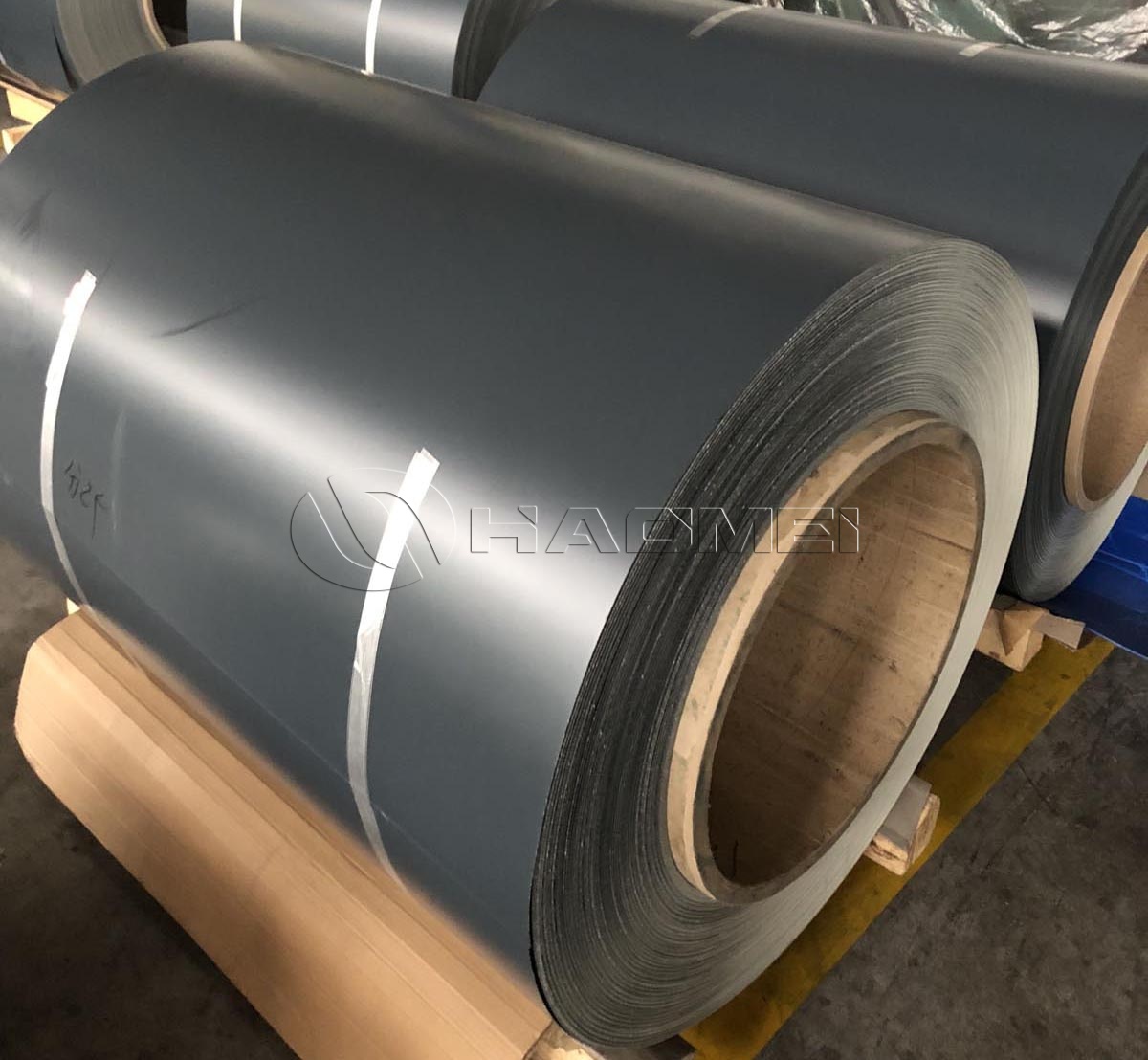
Why 5000 Series Aluminum Is Suited to Marine Atmospheres
The 5000 series is an aluminum-magnesium alloy family. Magnesium improves the strength and corrosion resistance of aluminum without the high density associated with many structural metals. In properly selected tempers, these alloys retain useful formability for roll forming, bending, stamping, and panel fabrication.
For coastal buildings, the material performance depends on the combined function of the alloy substrate, conversion treatment, primer, topcoat, reverse-side coating, and finished-edge protection. A durable coating does not replace sound alloy selection, and a corrosion-resistant alloy does not eliminate the need for a coating system appropriate for ultraviolet exposure and salt spray conditions.
Key material characteristics include:
Good resistance to atmospheric and marine-influenced corrosion
Higher strength than 1000 series and many 3000 series aluminum coils
Good formability for roofing profiles, flashings, cassette panels, and trims
Low weight, supporting efficient façade and roof system design
Compatibility with fluorocarbon, polyester, and specialty coil-coating systems
Stable appearance options in solid colors, metallic finishes, and textured surfaces
Common 5000 Series Alloys for Color Coated Coil
5005 Aluminum Alloy
5005 is a widely used architectural aluminum alloy with moderate strength, good forming characteristics, and a smooth surface suitable for decorative finishing. It is commonly specified for façade panels, aluminum composite panel skins, ceiling systems, interior-exterior transition areas, and non-load-bearing architectural cladding.
Its relatively consistent anodizing response also makes 5005 familiar in appearance-sensitive aluminum applications, although pre-painted coil performance is primarily governed by the coil coating system. For coated architectural sheet, 5005 Color Coated Aluminum Coil is suitable where flatness, finish quality, and fabrication flexibility are important.
5052 Aluminum Alloy
5052 is among the most common 5000 series alloys for coastal construction. It offers a useful balance of strength, bendability, and corrosion resistance. Compared with 5005, 5052 generally provides higher mechanical strength, making it suitable for profiled roofing, wall panels, shutters, gutters, flashings, and formed components exposed to demanding outdoor environments.
The magnesium content helps provide reliable marine-atmosphere durability when the coil is processed and installed with appropriate attention to cut edges, fasteners, drainage, and dissimilar-metal isolation. 5052 Color Coated Aluminum Coil is frequently used where coastal exposure and formed-profile performance are both central considerations.
5754 Aluminum Alloy
5754 provides good corrosion resistance and medium strength, with favorable performance in formed architectural parts. It is used for façade systems, roofing accessories, transport-adjacent structures, and panels requiring more strength than decorative-grade sheet. In coastal building projects, 5754 can be used for components where deformation resistance and marine atmospheric durability are important.
5454 and 5083 Aluminum Alloys
5454 and 5083 are higher-strength magnesium alloys used in more demanding applications. 5454 has good corrosion resistance and can perform well in elevated-temperature environments, while 5083 is known for high strength and strong marine corrosion resistance. For standard color-coated architectural coil, these alloys may be selected for specialized structural or high-load components rather than routine façade skins, depending on forming requirements, thickness, and coating compatibility.
Core Specifications of 5000 Series Color Coated Aluminum Coil
Product Specification Table
| Item | Typical Range or Option |
|---|---|
| Alloy | 5005, 5052, 5754, 5454, 5083 |
| Temper | O, H14, H16, H18, H22, H24, H32, H34, subject to alloy and thickness |
| Thickness | 0.20-3.00 mm for common architectural coil applications |
| Width | 20-1,600 mm, with common widths of 1,000 mm, 1,220 mm, 1,250 mm, and 1,500 mm |
| Coil inner diameter | 150 mm, 300 mm, 405 mm, 505 mm, or 508 mm |
| Coil weight | Typically 1-5 tonnes, subject to dimensions and handling requirements |
| Topcoat options | PE, SMP, HDP, PVDF, FEVE, and specialty fluoropolymer systems |
| Coating thickness | Commonly 20-25 μm for PE; 25-35 μm or higher for PVDF systems |
| Surface finish | Gloss, matt, textured, metallic, embossed, or custom color finish |
| Color standards | RAL, Pantone, custom color matching, or project-specific samples |
| Typical applications | Roofing, façades, wall cladding, soffits, flashings, gutters, shutters, and trim |
Actual dimensions, temper, coating build, and performance criteria are defined according to panel design, forming radius, exposure class, and relevant project standards.
Coil Coating Structure and Protective Function
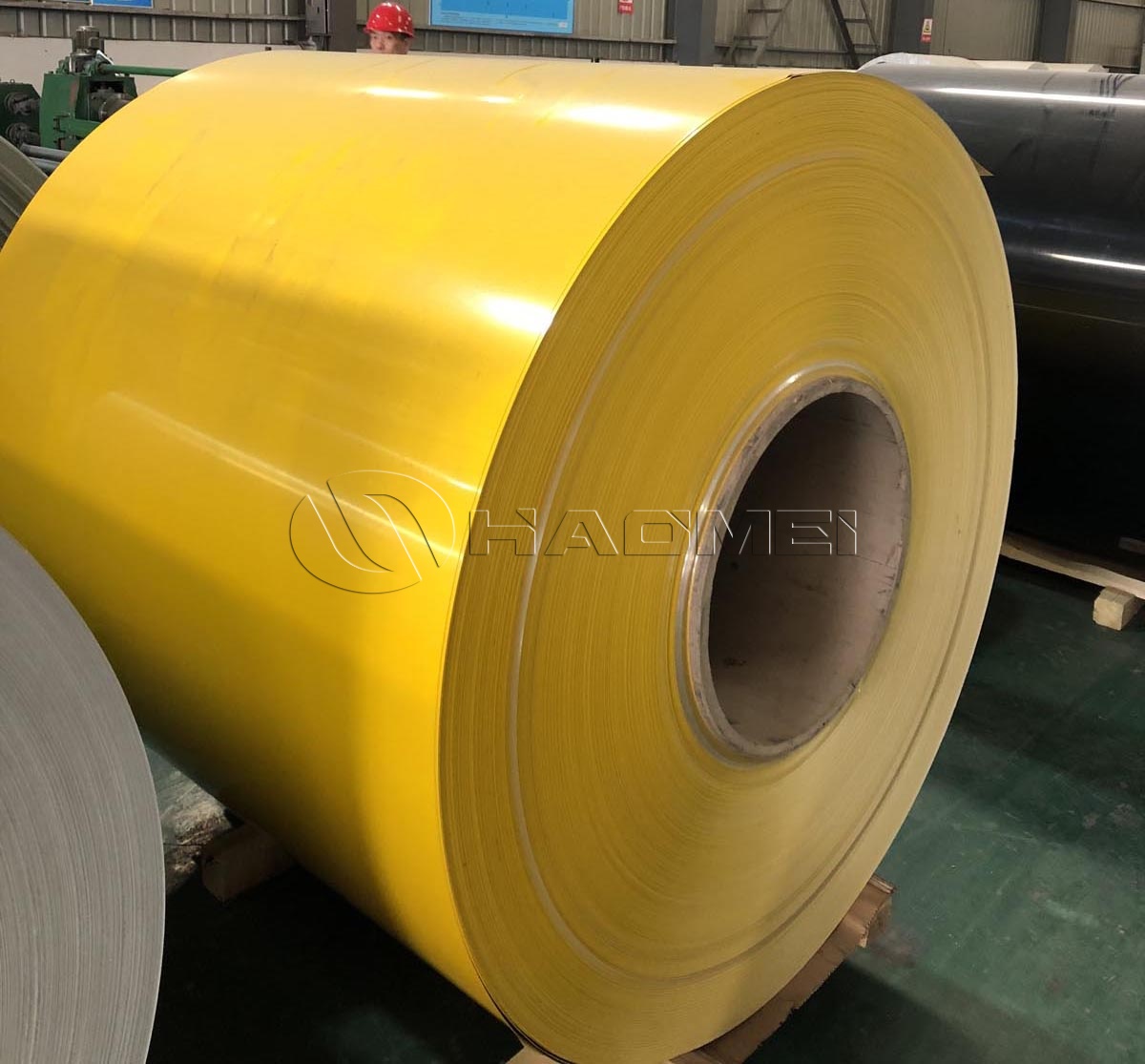
Color coated aluminum coil is produced through a continuous coil-coating process. The aluminum strip is cleaned, chemically pretreated, coated, oven-cured, and rewound under controlled conditions. This process creates a uniform protective film before fabrication, helping maintain consistent appearance across long panels and large building elevations.
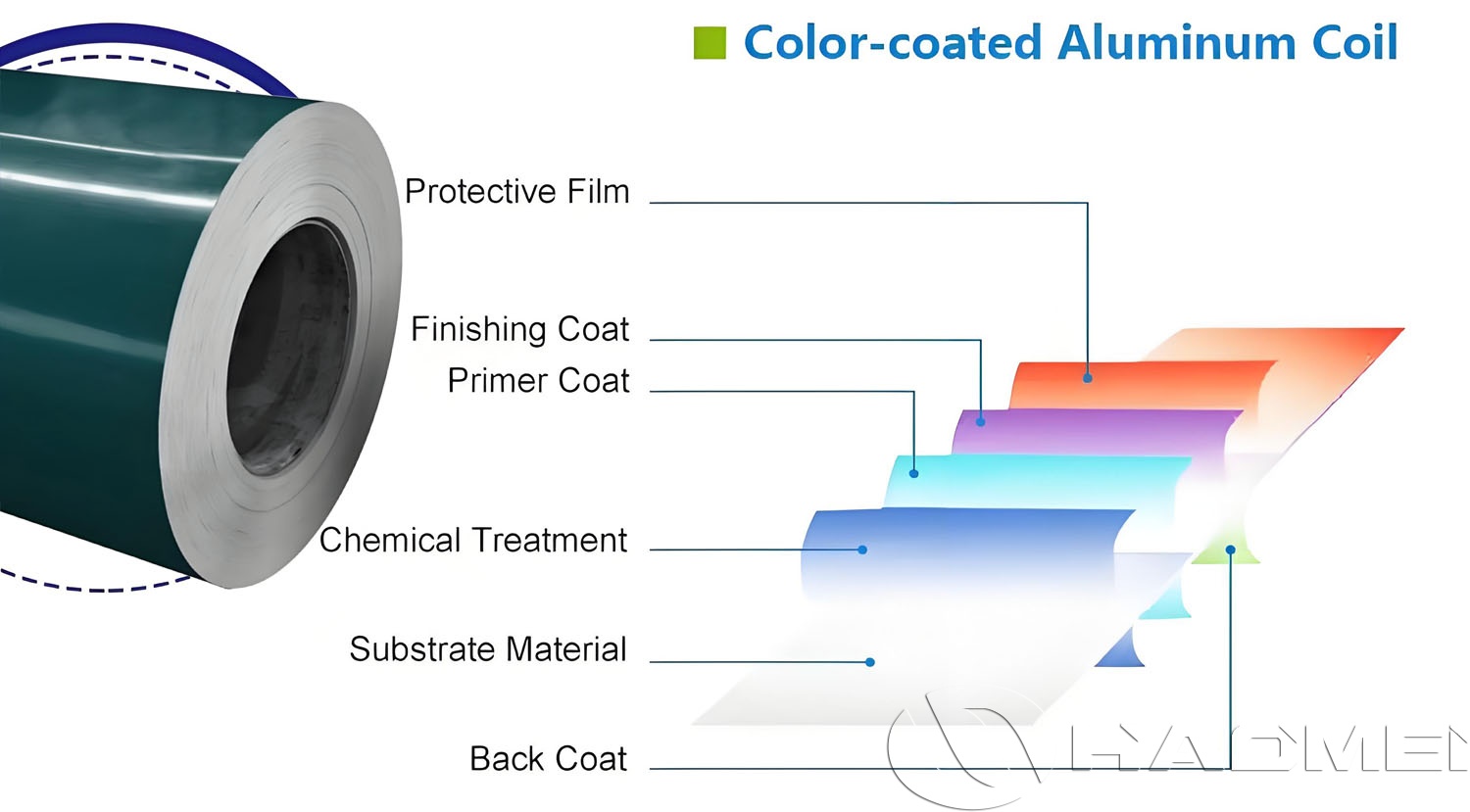
A typical coated construction includes:
5000 series aluminum substrate: Provides the base corrosion resistance, strength, and formability.
Chemical conversion treatment: Improves coating adhesion and supports corrosion resistance beneath the paint film.
Primer coat: Enhances bonding between the substrate and finish coat while adding barrier protection.
Topcoat: Delivers color, gloss, weatherability, ultraviolet resistance, and exterior durability.
Back coat: Protects the reverse side during fabrication and service, particularly in concealed or ventilated assemblies.
For exposed coastal façades and roofs, PVDF coated aluminum coil is often used because fluoropolymer finishes provide strong resistance to ultraviolet degradation, chalking, fading, and atmospheric pollutants. Coating selection also considers color, since darker colors and high-heat-absorption finishes can produce greater surface temperatures than light colors.
Coating Systems for Coastal Roofs and Facades
PE Coating
Polyester, or PE, coating offers broad color availability and economical decorative performance. It can be applied to sheltered architectural elements and lower-exposure applications. In severe marine environments, its service performance depends strongly on coating thickness, pigment quality, surface maintenance conditions, and the extent of direct weather exposure.
SMP and HDP Coatings
Silicone-modified polyester and high-durability polyester systems provide improved weathering compared with conventional PE coatings. These systems can be used where stronger outdoor durability is required while maintaining a wide selection of colors and gloss levels.
PVDF and FEVE Coatings
PVDF and FEVE fluoropolymer coatings are commonly associated with high-performance exterior building envelopes. They provide excellent color and gloss retention under intense sunlight and resist many environmental contaminants. In coastal areas, their value lies in maintaining a stable protective and decorative surface during prolonged exposure to moisture, ultraviolet radiation, and salt-bearing air.
A coastal coating system is evaluated as a complete assembly. Pretreatment quality, primer chemistry, film thickness, cure control, and edge coverage all influence the long-term condition of the finished panel.
Coastal Building Applications
5000 series pre-painted aluminum coil can be processed into a variety of building components:
Standing-seam and corrugated roofing sheets
Metal roof flashings, ridge caps, valleys, and eave details
Ventilated façade panels and rainscreen cladding
Aluminum composite panel skins and cassette panels
Curtain-wall spandrels, column covers, and decorative bands
Soffits, fascia boards, coping systems, and parapet cladding
Rainwater goods, including gutters and downpipes
Roller shutters, louvers, sunshades, and exterior ceiling panels
The low density of aluminum reduces dead load on the building structure. This is particularly useful for large façade areas, retrofit cladding systems, and roof assemblies where weight control supports efficient structural design.
Fabrication and Installation Considerations
The corrosion resistance of 5000 series aluminum supports coastal durability, but system-level detailing remains essential. Forming operations should use suitable bend radii to prevent excessive strain in the coating film, particularly with thicker or lower-ductility tempers. Protective films, clean tooling, and controlled handling help reduce surface scratches before installation.
At installation, water-shedding geometry and ventilation influence the duration of surface wetness. Areas that retain salt deposits or standing water, such as horizontal ledges, unventilated overlaps, and poorly drained joints, can experience more severe local exposure than freely washed vertical surfaces.
Fasteners, brackets, sealants, and adjacent metals should be selected to limit galvanic corrosion. Direct contact between aluminum and copper, untreated carbon steel, or other incompatible metals should be avoided or separated with suitable isolating materials. Cut edges, penetrations, folded seams, and damaged coating areas require consistent detailing because they are the locations most likely to experience concentrated chloride exposure.
For high-visibility coastal façades, color consistency is maintained by controlling alloy source, coating batch, gloss level, metallic pigment orientation, and panel direction during fabrication. Coils intended for the same elevation are commonly processed from coordinated production lots to maintain a uniform architectural appearance.
-
PVDF Coated Aluminum Coil for Facade Panels
PVDF coated aluminum coil for facade panels, covering alloys, coating structure, specifications, durability, and processing for curtain wall systems use.
2026-05-25
-
5052 Color Coated Aluminum Coil For Marine Use
5052 color coated aluminum coil for marine use delivers salt spray resistance and durability with PVDF/PE systems, controlled coil coating process, and stable H32 properties.
2026-01-23
-
1000 Series Color Coated Aluminum Coil For Roofing
1000 Series color coated aluminum coil for roofing is positioned as a lightweight, high-corrosion-resistance roof stock for roll-formed panels, corrugated sheets, ridge caps, flashings, and rainwater systems.
2026-01-19
Contact Directly
-

ADD: No.14 Waihuan Road, CBD, Zhengzhou, China
-

WhatsApp: +86-18703635966
-

E-MAIL: sales@alummc.com
