

News
 By Hermione
3003 3004 3005 Color Coated Aluminum Coil
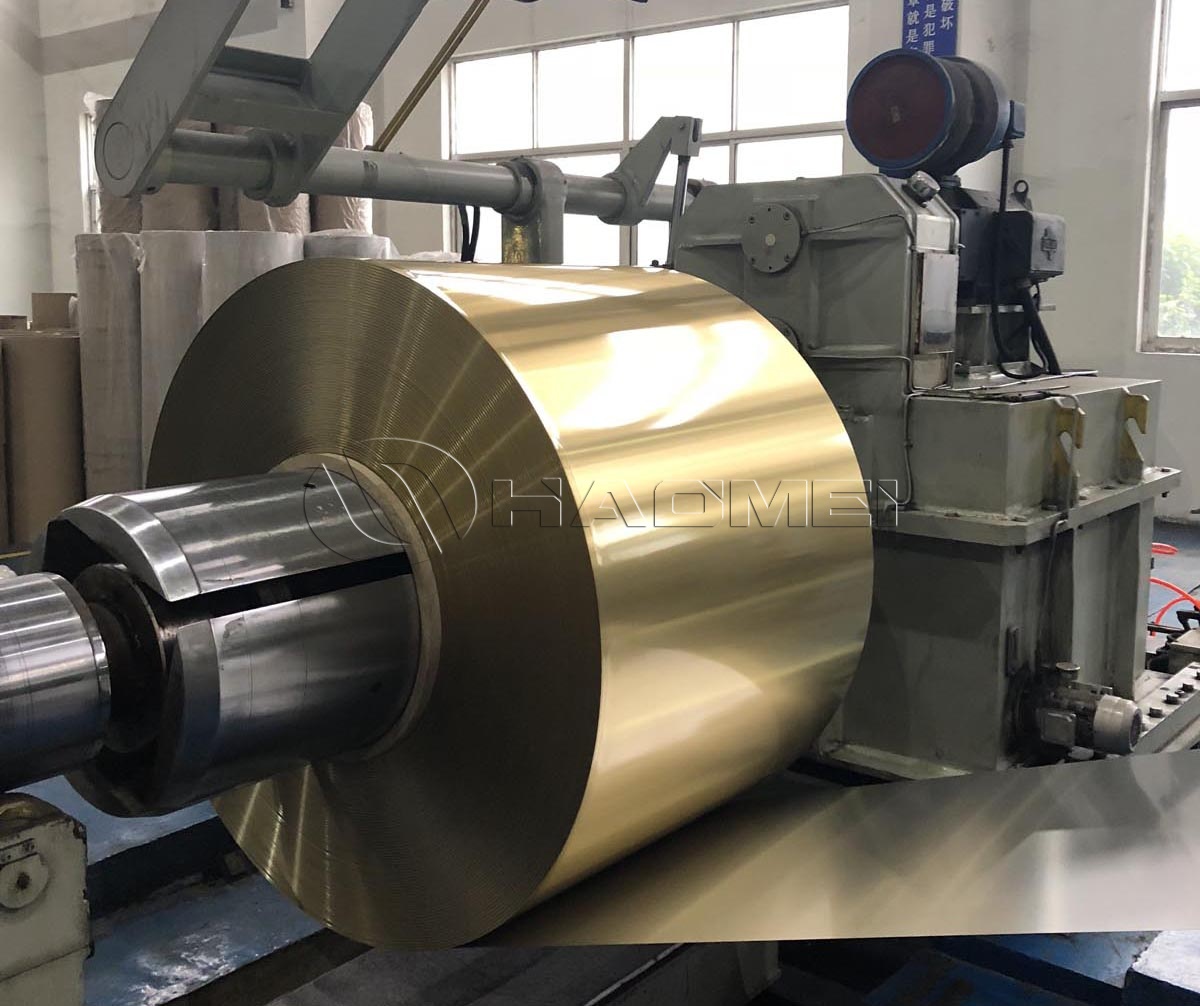
3003, 3004, and 3005 color coated aluminum coil are widely used in architectural and industrial sheet applications where a balance of formability, corrosion resistance, surface appearance, and coating durability is required. These 3xxx series manganese-based alloys are commonly selected for roofing, wall cladding, ceilings, gutters, composite panel skins, shutter systems, insulation jacketing, and general roll-formed decorative parts.
Product Positioning
Compared with 1xxx series coated aluminum, 3xxx series alloys offer higher strength while maintaining good processing performance. This makes them suitable for components that require bending, profiling, rib forming, and long-term outdoor service. In practical production, these alloys are often supplied with PE or PVDF coating systems depending on the end-use environment, gloss requirement, and weather resistance target.
Among them, 3003 Color Coated Aluminum Coil is a common general-purpose grade, while 3004 and 3005 are more often chosen when a higher strength level or improved panel stiffness is needed.
Basic Structure of Color Coated Aluminum Coil
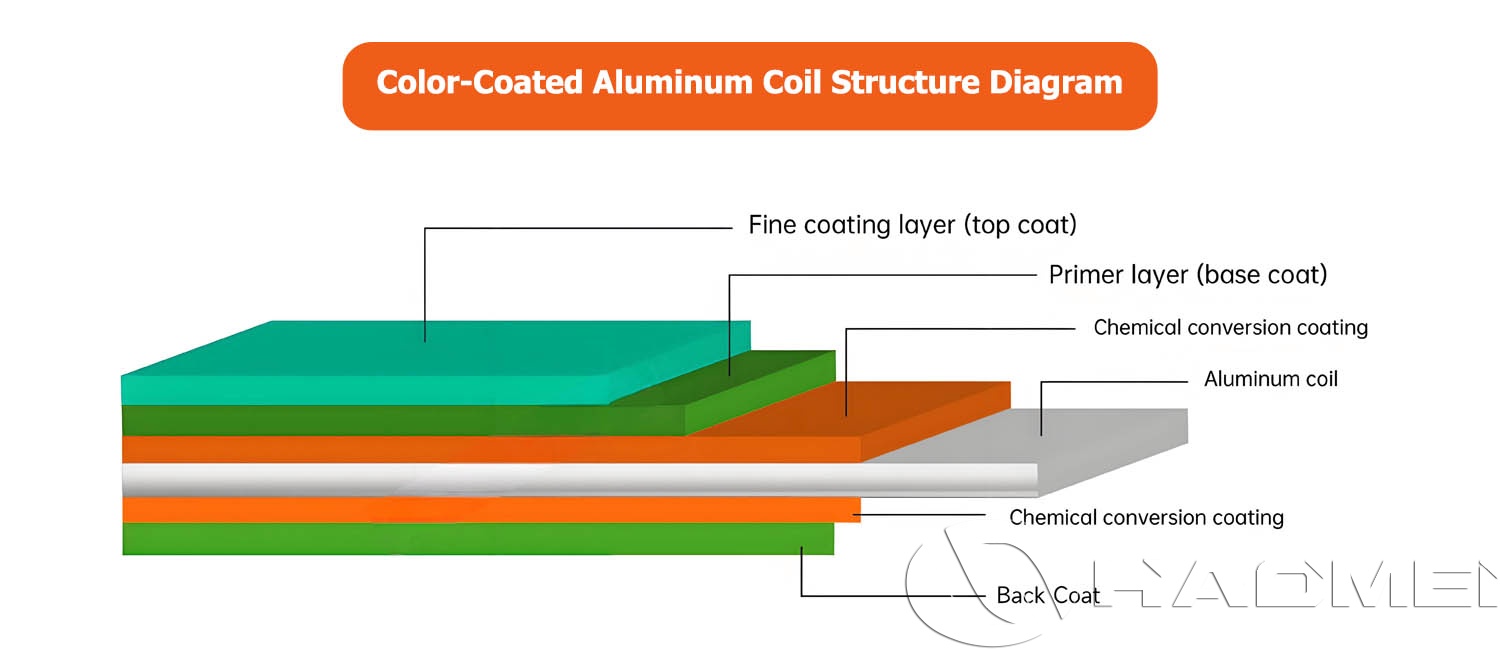
Color coated aluminum coil is not only an alloy substrate with paint on the surface. It is a layered product manufactured through pretreatment, primer coating, top coating, curing, and controlled rewinding. The final performance depends on the combined effect of substrate quality, pretreatment chemistry, paint selection, dry film thickness, and curing stability.
Typical structure includes:
Aluminum alloy substrate
Chemical pretreatment layer
Primer coating
Top coating
Back coating or service coating
For outdoor architectural use, coating systems are usually based on polyester, SMP, or PVDF. For applications with higher UV exposure and stricter color retention requirements, PVDF Coated Aluminum Coil is frequently specified.
Core Alloy Differences: 3003, 3004, and 3005
3003 color coated aluminum coil
3003 aluminum alloy is the most widely used representative of the 3xxx series. It contains manganese as the main alloying element and provides good corrosion resistance, stable forming behavior, and moderate strength. In color coated form, it is well suited for standard roofing sheets, ceiling panels, rainwater systems, fascia, insulation cladding, and decorative trims.
Typical characteristics:
Good bendability and roll-forming performance
Reliable corrosion resistance in normal atmospheric environments
Smooth and stable painted surface
Broad availability in multiple thickness and width ranges
Economical option for general architectural use
3004 color coated aluminum coil
3004 aluminum alloy contains manganese with added magnesium, giving it a higher strength level than 3003. This alloy is suitable where improved rigidity, dent resistance, or shaping strength is needed. It is often used for roofing panels with larger spans, profiled sheets, ceiling carriers, and formed building components.
Typical characteristics:
Higher strength than 3003
Good formability for roll forming and stamping
Better structural support for shaped panels
Suitable for applications requiring improved stiffness with coated finish
3005 color coated aluminum coil
3005 aluminum alloy is also a manganese-based alloy with magnesium addition, and it is frequently used where corrosion resistance, coating adhesion, and moderate-to-high strength must be balanced. In the market, 3005 is often associated with building sheet, curtain wall accessories, roofing, shutters, and decorative facing materials.
Typical characteristics:
Strength generally higher than 3003
Good outdoor corrosion resistance
Stable coating compatibility
Suitable for decorative and semi-structural formed products
Although 3005 is very close in practical use to some adjacent building grades, alloy choice still depends on mechanical target, forming radius, panel design, and service environment.
Coating Systems and Surface Performance
The substrate alloy determines the mechanical base, while the coating system determines surface durability and visual performance.
PE coating
PE coated aluminum coil is commonly used for interior decoration, short-to-medium weather exposure, sign boards, ceiling systems, and general façade parts in relatively mild environments. It offers:
Good flexibility
Broad color range
Stable gloss control
Economical processing
PVDF coating
PVDF coated aluminum coil is preferred for exterior applications requiring stronger weather resistance, color retention, and chalk resistance. It is widely used in curtain walls, roofing, airport buildings, stations, industrial façades, and high-exposure cladding systems.
Typical benefits include:
Excellent UV resistance
Better long-term gloss retention
Strong resistance to chalking and fading
Good chemical and pollution resistance
Core Specifications of 3003 3004 3005 Color Coated Aluminum Coil
Core Specifications Table
| Item | Typical Range / Option |
|---|---|
| Substrate alloys | 3003, 3004, 3005 |
| Temper | H14, H16, H18, H24, H26, customized |
| Thickness | 0.20 mm - 2.00 mm |
| Width | 30 mm - 1600 mm |
| Coil inner diameter | 405 mm, 505 mm, customized |
| Coating type | PE, PVDF, SMP, special functional coatings |
| Top coating thickness | PE: 14-25 μm, PVDF: 25-35 μm |
| Back coating thickness | 5-10 μm or customized |
| Color | RAL colors, custom colors, metallic, matte, textured |
| Surface finish | Glossy, matte, embossed, brushed, patterned |
| Adhesion | Typically Grade 0-1 depending on standard |
| Impact resistance | According to project specification and coating system |
| T-bend | Typically 0T-3T depending on alloy, temper, and coating |
| Application fields | Roofing, wall cladding, ceiling, shutter, ACP skin, trim |
| MOQ | 1-3 tons |
Actual specification selection should match forming method, panel geometry, paint system, and durability target. For example, thinner gauges may suit ceilings and trims, while thicker gauges are generally used for roofing, profiled sheets, and façade panels.
Application Scenarios
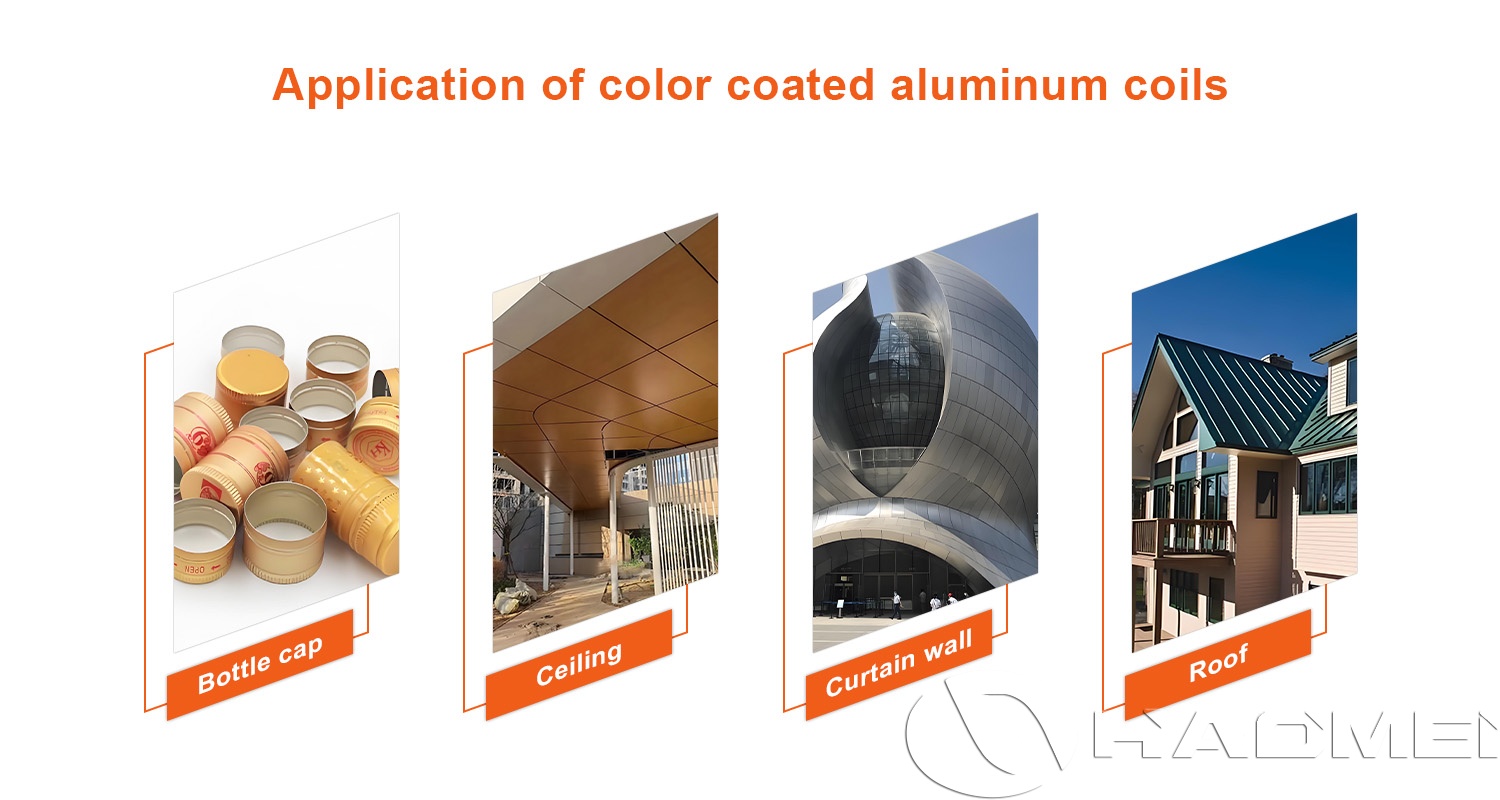
3xxx series color coated aluminum coil is used across a wide range of sectors because it combines decorative value with process adaptability.
Building envelope systems
These alloys are widely used in:
Roofing sheets
Wall cladding panels
Corrugated sheets
Standing seam systems
Gutter and downpipe systems
Soffits and fascia boards
Interior and decorative systems
They are also suitable for:
Suspended ceilings
Linear ceiling strips
Partition facings
Decorative panels
Lighting and equipment covers
Industrial fabricated parts
Because of their good forming performance, they are used for:
Insulation jacketing
Appliance housings
Ventilation duct covers
Roller shutter slats
General roll-formed shells
How the Alloy Choice Affects End Use
When comparing 3003, 3004, and 3005, the main practical differences are usually related to strength, stiffness, and forming behavior.
3003 is often selected for standard decorative and lightly loaded formed parts.
3004 is preferred when a stronger substrate is required for profiled panels or enhanced dent resistance.
3005 is chosen for building sheet and decorative applications where a combination of strength, coating performance, and outdoor resistance is important.
In coil coating production, alloy consistency is also important for maintaining stable flatness, paint adhesion, and post-forming appearance. A well-controlled substrate helps reduce surface waviness, orange peel mismatch, edge cracking during bending, and coating damage after roll forming.
Manufacturing and Quality Considerations
The performance of 3003, 3004, and 3005 color coated aluminum coil depends not only on nominal alloy grade but also on the quality of the entire manufacturing route.
Key control points include:
Substrate thickness tolerance and flatness
Surface cleanliness before pretreatment
Pretreatment film uniformity
Primer and topcoat thickness control
Curing temperature matching the coating chemistry
Rewind tension control to avoid pressure marks
Color consistency between production batches
For exterior-grade products, performance is typically evaluated through tests such as:
Coating adhesion
Pencil hardness
T-bend
Impact resistance
Solvent resistance
Salt spray resistance
Humidity resistance
Accelerated weathering
Color difference evaluation
These indicators are especially important for projects with strict visual standards and long outdoor service cycles.
Other commonly used alloy grades
Although this article focuses on 3003, 3004, and 3005, the color coated aluminum coil family includes other alloys selected for different performance priorities.
1050 / 1060 / 1100: high purity grades with excellent formability, commonly used for signs, insulation, and interior decoration.
3003 / 3004 / 3005 / 3105: mainstream architectural and decorative grades with balanced strength and corrosion resistance.
5005 / 5052 / 5754: higher-strength and more corrosion-resistant grades used for demanding decorative or industrial environments.
8011: commonly used for closure, packaging, and some special thin-gauge applications.
Within this range, 3xxx series products remain one of the most practical solutions for coated building materials because they provide a favorable combination of mechanical properties, surface quality, and coating compatibility.
-
5052 Color Coated Aluminum Coil for Fuel Tanks
Learn how 5052 color coated aluminum coil supports fuel tank applications with good corrosion resistance, formability, coating options, and stable processing.
2026-04-03
-
PE Coated Aluminum Coil 1000 Series for Electronics
PE coated aluminum coil in 1000 series provides clean surfaces, easy forming, and stable color for electronics housings, panels, enclosures, and trim.
2026-09-07
-
PVDF Coated Aluminum Coil For Cold Climates
PVDF coated aluminum coil for cold climates combines durable fluoropolymer protection, alloy options, and flexible prepainted finishes for roofs and facades.
2026-08-04
Contact Directly
-

ADD: No.14 Waihuan Road, CBD, Zhengzhou, China
-

WhatsApp: +86-18703635966
-

E-MAIL: sales@alummc.com